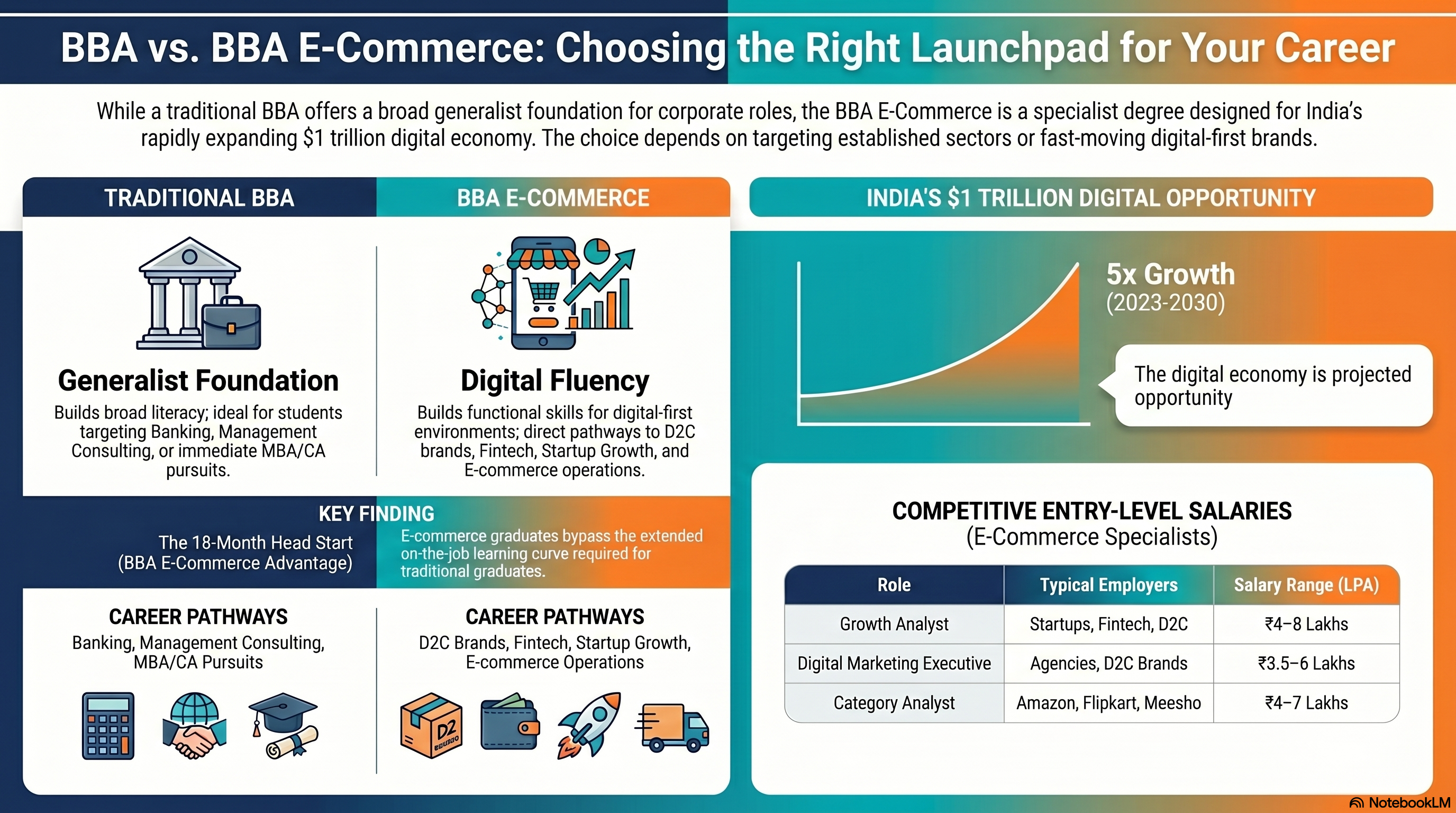
Both lead to a business degree. But the industries they open, the roles they prepare you for, and the skills they build are increasingly distinct. Here is what that difference actually means for your career.
For most of the last two decades, the BBA was a generalist degree. You studied finance, marketing, HR, and operations, got a broad view of how business worked and then figured out the rest on the job or through a postgraduate programme. The specialisation happened after the degree, not during it.
That model is under pressure. The entry-level job market has changed significantly. Recruiters in digital-first companies, e-commerce platforms, D2C brands, digital agencies, and fintech firms are increasingly looking for graduates who arrive with functional, applicable skills, not just theoretical foundations. And the question of which is better, BBA or BBA E-Commerce, has moved from being a niche admissions debate to a genuinely consequential career decision.
The answer isn't simple, and anyone who gives you a simple answer without asking about your goals is giving you the wrong one. What this blog does is give you the framework to answer it for your specific situation.
- What the Shift in Hiring Actually Means
- The Confusion Most Students Are Sitting With
- Who Should Choose Which And When
- What a Well-Designed BBA E-Commerce Programme Actually Builds
- Curriculum to Career: What Each Programme Builds and Where It Goes
- Career Outcomes: What Each Degree Opens and Where the Paths Diverge
- Job Roles After BBA E-Commerce: What the Entry Market Actually Looks Like
- Which Specialisation Is Actually Best for the Future?
- Does BBA E-Commerce Have Better Job Opportunities? An Honest Assessment
- Reading the Five-Year Trajectory
- Is BBA E-Commerce Better Than Regular BBA? The Honest Answer
- Key Takeaways
- FAQs
What the Shift in Hiring Actually Means
India's digital economy crossed USD 200 billion in 2023 and is projected to reach USD 1 trillion by 2030. That number matters not because it signals an abstract opportunity but because it represents millions of roles that require a specific kind of business graduate: one who understands how digital commerce works, how customer acquisition economics function online, how logistics and fulfilment connect to customer experience, and how data drives every significant business decision in a digital channel.
The BBA E-Commerce career scope has expanded because the industry it serves has expanded faster than the talent pipeline filling it. E-commerce, quick commerce, social commerce, and D2C brands are not a niche segment of the economy anymore. They are among the most active hiring sectors for business graduates, and they are hiring with increasing specificity about what they need.
In most cases, a traditional BBA graduate entering a digital-first company spends the first 12–18 months learning on the job what a BBA E-Commerce graduate knew before joining. That gap is not insurmountable, but it is real, and it affects early career trajectory, first performance review, and time-to-promotion. Companies that move fast don't have patience for extended onboarding curves.
The hidden implication in the hiring data: specialisation at the undergraduate level is becoming a signal of intent, not just a subject choice. A candidate who has studied digital marketing, e-commerce operations, and platform analytics alongside core business fundamentals is telling a recruiter something about how they think, not just what they know. That signal matters in a competitive entry-level market.
Understanding the BBA vs BBA E-Commerce difference requires looking at three dimensions simultaneously: curriculum architecture, career pathway, and the type of professional identity each degree builds. A traditional BBA builds a generalist business thinker. A BBA E-Commerce builds a business thinker who is specifically equipped for digital commerce environments. The question is which of those profiles the industry you want to enter is hiring for.
The Confusion Most Students Are Sitting With
The students who struggle most with this decision are usually the ones who haven't yet figured out what kind of business career they want. They know they want to work in business. They know digital is important. But they haven't mapped that interest to a specific industry, function, or role type, which makes the specialisation choice feel like a gamble rather than a strategic decision.
A second source of confusion: many students believe that a specialised degree limits them to choosing e-commerce, which locks them out of finance roles, HR, or consulting. This is a misreading of how the labour market works. Specialisation at the undergraduate level doesn't close doors; it opens specific ones faster. The generalist path isn't safer; it's just less directed.
One of the biggest gaps in how this decision gets made is the assumption that the traditional BBA is the 'safe' choice. In 2026, the safe choice is the one that prepares you for the industries that are actually hiring at scale. E-commerce, D2C, quick commerce, and digital marketing are those industries. A traditional BBA is the safer choice for students entering banking, consulting, or corporate functions, not for students whose instinct is toward digital business. Choosing generic when your interest is specific is not cautious. It is a misread.
The career dilemma compounds when students talk to family members or school counsellors whose professional frame of reference is a decade old. The advice they receive, ' a regular BBA is more respected', 'specialisation limits you', 'do MBA after', is not wrong in every context. But it is often applied to a job market that no longer resembles the one in which the advice was formed.
Who Should Choose Which And When
Who should seriously consider BBA E-Commerce:
- Students who are drawn to digital business, online retail, startup culture, or D2C brands and want to understand how these models work from the inside
- Those who are comfortable with data, enjoy understanding consumer behaviour, and find the mechanics of digital marketing or platform operations genuinely interesting
- Students who want to work in fast-moving, metrics-driven environments where performance is visible, and learning curves are steep
- Those targeting roles in e-commerce companies, digital agencies, brand marketing, logistics-tech, or fintech at the entry level
Who should consider a traditional BBA:
- Students who are clear about entering banking, finance, consulting, or large corporate functions sectors, where the generalist business foundation and network of a traditional programme are more directly valued
- Those who are undecided about their career direction and want the flexibility a broader curriculum provides before committing to a domain
- Students who plan to pursue an MBA or professional certification (CA, CFA) immediately after graduation, the traditional BBA's broader foundation aligns better with those entry requirements
When is BBA E-Commerce the right time?
If a student has a genuine interest in how
digital businesses work and can articulate even a rough career direction involving online commerce,
digital marketing, or tech-enabled business, now is the right time. The sector is in a phase of
sustained growth, and the students entering it at the undergraduate level today will have a structural
advantage over those who pivot in later.
What happens if the fit question is ignored?
Students who choose BBA E-Commerce
without a genuine interest in the domain tend to disengage from the applied and data-heavy modules that
differentiate it from a traditional programme and graduate with neither the specialist edge of the
e-commerce track nor the broad foundation of the generalist track. The result is the worst of both
worlds: a specialised degree without specialised capability.
What a Well-Designed BBA E-Commerce Programme Actually Builds
The question of whether I should choose BBA E-Commerce gets easier to answer when you understand what the programme is structurally designed to produce and how that differs from a traditional BBA's design logic.
A well-designed BBA E-Commerce programme doesn't simply add a digital marketing module to a standard business curriculum. It reorganises the entire learning architecture around the logic of digital commerce: how products are built for online markets, how customers are acquired and retained through digital channels, how fulfilment and supply chain work in an e-commerce context, and how data underpins every significant decision. Core business modules, finance, operations, and management are taught through this lens rather than in isolation.
The learning-to-career translation: digital commerce fundamentals build industry fluency → applied modules in marketing technology, analytics, and operations build functional skill → live projects and internships in digital businesses build portfolio and professional context → degree plus demonstrated capability builds hiring confidence in the specific roles the programme is designed for.
Want to explore careers in digital commerce?
Curriculum to Career: What Each Programme Builds and Where It Goes
The skills required for e-commerce careers are distinct enough from traditional business skills that the curriculum differences between the two programmes are more than cosmetic. Here is how they compare across the dimensions that matter most for early career outcomes.
| Curriculum Dimension | Traditional BBA | BBA E-Commerce |
|---|---|---|
| Core business foundation | Finance, HR, Marketing, Operations, Management | Same foundation taught through a digital commerce lens |
| Marketing focus | Traditional marketing principles, brand management, and advertising | Digital marketing, performance marketing, SEO/SEM, content strategy, social commerce |
| Operations coverage | Supply chain principles, logistics theory, operations management | E-commerce logistics, last-mile delivery, warehouse management, reverse logistics |
| Technology exposure | Basic IT for business, ERP introduction | E-commerce platforms, marketing tech stack, analytics tools, automation basics |
| Data and analytics | Basic statistics, market research methods | Web analytics, customer analytics, campaign performance, conversion optimisation |
| Finance application | Corporate finance, investment analysis, and budgeting | Unit economics, P&L for digital businesses, CAC/LTV modelling, pricing strategy |
| Entrepreneurship | General business planning, case studies | D2C business models, marketplace strategy, digital venture building |
| Industry exposure | Broad FMCG, BFSI, manufacturing, consulting | E-commerce, D2C, retail-tech, logistics-tech, digital agencies |
The table makes clear that the difference is not about rigour or depth, it is about direction. A traditional BBA builds broad business literacy. A BBA E-Commerce builds targeted digital commerce fluency. Both are rigorous. The question is which of those profiles maps better to the career the student is actually pursuing.
Career Outcomes: What Each Degree Opens and Where the Paths Diverge
The contrast in career options after BBA E-Commerce vs BBA is most visible at the entry level, the first two to three years after graduation, when the specificity of a degree either accelerates or slows the transition into a role.
| Role Type | BBA E-Commerce | Traditional BBA | Overlap |
|---|---|---|---|
| Digital Marketing Executive | Strong direct path curriculum maps directly | Possible, but requires additional self-learning | Low |
| E-Commerce Operations Analyst | Strong module coverage aligns with the role | Possible with internship experience | Low |
| Business Development Executive | Strong, especially in a digital/startup context | Strong, particularly in traditional sectors | High |
| Category Manager (Marketplaces) | Strong understands platform mechanics | Possible but slower ramp-up | Medium |
| Brand Manager (D2C) | Strongly trained in digital brand building | Possible, depending on digital upskilling | Medium |
| Financial Analyst / Banking | Possible needs additional financial focus | Strong direct path | Low |
| HR / Talent Management | Possible generalist modules cover basics | Strong, dedicated HR curriculum | Low |
| Management Consultant (entry) | Possible needs a strong analytical foundation | Strong traditional BBA aligns well | Medium |
| Startup / Entrepreneurship | Very strong built for a digital venture context | Possible, depending on individual initiative | Medium |
| Supply Chain / Logistics (digital) | Strong e-commerce logistics is core | Possible general SCM knowledge applies | Medium |
The table above reveals the real answer to the BBA vs BBA E-Commerce question: it is not about which degree is better, it is about which set of first roles you are targeting. If your first role is in a digital-first company, a D2C brand, an e-commerce platform, or a digital agency, BBA E-Commerce gives you a head start that matters at the entry level. If your first role is in banking, consulting, or a large corporate function, a traditional BBA is the stronger fit. The mistake is choosing one while planning for the other.
Job Roles After BBA E-Commerce: What the Entry Market Actually Looks Like
The range of job roles is wider than most students realise and extends well beyond the obvious e-commerce platform roles.
| Role | What You Do | Typical Employers | Starting Salary Range |
|---|---|---|---|
| Digital Marketing Executive | Run performance campaigns, manage SEO, handle social media and content strategy | D2C brands, agencies, e-commerce firms | Rs. 3.5–6 LPA |
| E-Commerce Executive | Manage product listings, marketplace operations, catalogue, and seller coordination | Amazon, Flipkart, Meesho, brand portals | Rs. 3–5.5 LPA |
| Category Analyst | Track sales data, manage assortment, and analyse category performance | Large e-commerce platforms, retail chains | Rs. 4–7 LPA |
| Growth Analyst | Analyse acquisition funnels, run A/B tests, optimise conversion metrics | Startups, D2C brands, fintech | Rs. 4–8 LPA |
| Supply Chain Coordinator | Coordinate with logistics partners, track fulfilment SLAs, and manage returns | E-commerce companies, logistics-tech firms | Rs. 3.5–6 LPA |
| Content Strategist | Plan and manage digital content across platforms for brand and SEO objectives | Agencies, media companies, D2C brands | Rs. 3–5.5 LPA |
| Business Development Executive | Identify and onboard sellers, manage partnerships, and drive platform expansion | Marketplaces, SaaS, B2B platforms | Rs. 4–7 LPA |
Salary progression in these roles is directly linked to measurable performance campaign ROI, category growth, and conversion improvement, which means strong performers move faster than in more conventional corporate tracks. The digital business environment rewards demonstrated impact over tenure, which creates an accelerated trajectory for motivated early-career professionals.
Which Specialisation Is Actually Best for the Future?
The industries growing fastest in India, e-commerce, fintech, health-tech, edtech, logistics-tech, and D2C consumer brands, all share a common characteristic: they are digital-first businesses where data drives decisions, and digital channels drive revenue. A BBA specialisation that builds fluency in this operating model will have stronger demand tailwinds than one that doesn't.
At the same time, traditional business functions, such as finance, consulting, HR, and general management, are not declining. They are stable, well-compensated, and remain the primary career destination for a large proportion of BBA graduates. The question is not whether those paths are viable. It is whether they are the paths the student is actually drawn to.
Does BBA E-Commerce Have Better Job Opportunities? An Honest Assessment
In terms of volume, the hiring pool for digital and e-commerce roles in India is growing faster than for traditional business roles at the entry level. The number of companies hiring digital marketing executives, e-commerce analysts, and growth managers has expanded significantly over the last five years and shows no sign of contracting. In that sense, yes, the opportunity set is expanding.
In terms of type, BBA E-Commerce opens a specific set of roles in digital-first companies. Traditional BBA opens a broader set of roles across all industries. Neither is categorically better; the better degree is the one that opens the roles you actually want.
Reading the Five-Year Trajectory
The BBA E-Commerce future scope over the next three to five years is shaped by several structural forces that are unlikely to reverse.
India's e-commerce market is projected to reach USD 350 billion by 2030. Quick commerce, social commerce, and rural e-commerce are the three fastest-growing sub-segments, each creating distinct categories of business roles. Simultaneously, every traditional retailer, FMCG company, and consumer brand is building its own digital commerce capability, which means BBA E-Commerce skills are increasingly valued outside pure e-commerce companies and inside every company that sells anything online. The addressable career market for this degree is expanding, not contracting.
The roles that will be most in demand over this period: professionals who can manage omnichannel commerce (the integration of online and offline), those who understand data-driven personalisation at scale, and those who can run digital brand operations for international markets. Students who build these competencies during their degree through electives, internships, and live projects will be well-positioned for the roles the industry will most actively be hiring for.
Is BBA E-Commerce Better Than Regular BBA? The Honest Answer
BBA E-Commerce is better if: you are entering a digital-first industry, you want roles in e-commerce, D2C, or digital marketing, you are interested in data-driven business environments, and you want your degree to do some of the skills-signalling work for you at the entry level.
A traditional BBA is better if: you are entering banking, consulting, or corporate functions, you are undecided about your career direction and want flexibility, or you plan to pursue an MBA or professional certification immediately after.
Neither is universally better. The one that is better is the one that aligns with what you actually want to do. The honest failure mode is choosing a traditional BBA because it feels safer while genuinely wanting a career in digital commerce and then spending two years post-graduation trying to build the skills the degree didn't provide.
Key Takeaways
- BBA E-Commerce and traditional BBA are not ranked degrees; they are differently directed ones. The right choice depends entirely on the industry and role type the student is targeting.
- BBA E-Commerce builds targeted digital commerce fluency, digital marketing, e-commerce operations, platform analytics, and D2C business mechanics that traditional BBA does not cover at the same depth.
- Traditional BBA remains the stronger choice for students targeting banking, consulting, core corporate functions, or postgraduate pathways like MBA or CA.
- The entry-level job market for digital and e-commerce roles is growing faster than for traditional business roles. BBA E-Commerce graduates are entering a sector with strong and sustained demand.
- Specialisation at the undergraduate level is increasingly a signal of intent to recruiters, not a limitation. Choosing a specialisation that matches genuine career interest is a strategic advantage, not a risk.
- The most important variable in this decision is honest self-knowledge of which industry you actually want to work in, and which degree builds the profile for it?
Frequently Asked Questions
Not categorically, but potentially yes for students entering digital-first industries. BBA E-Commerce is better suited to students whose career direction involves e-commerce platforms, D2C brands, digital marketing, or logistics-tech. It builds specific, applicable skills that are immediately relevant to how those companies hire and operate. A regular BBA is better suited to students entering traditional finance, consulting, large-scale corporate functions, or those who plan to pursue an MBA immediately after graduation. The mistake is applying a blanket preference rather than matching the degree to the specific career goal.
In terms of absolute volume of opportunities, both have strong hiring markets. The distinction is in the type and sector: BBA E-Commerce has better opportunities in digital-first sectors, which are growing faster than traditional sectors at the entry level. Traditional BBA has stronger pathways into banking, consulting, and established corporate environments. The relevant measure is not which has more opportunities in total, but which has more opportunities in the specific career direction the student is pursuing. On that measure, for students targeting digital business careers, BBA E-Commerce has the stronger, more direct pathway.
Yes, provided the student is genuinely interested in digital commerce and chooses a programme from an institution with strong industry connections and placement infrastructure in the digital sector. India's e-commerce economy is in a phase of sustained structural growth. The sectors hiring BBA E-Commerce graduates, e-commerce platforms, D2C brands, digital agencies, logistics-tech, and retail-tech are among the most active hiring environments for business graduates in the country. The degree's relevance is not speculative. It is grounded in current and projected hiring data. The important caveat: the degree works best for students who engage with the applied and analytical modules deeply, not those who treat it as a credential acquisition exercise.
Yes, and it is a strong combination for specific career directions. A BBA E-Commerce followed by an MBA, particularly with specialisations in marketing, strategy, or entrepreneurship, creates a profile that is genuinely differentiated: undergraduate digital commerce fluency combined with postgraduate management and strategy depth. This combination is well-suited for roles in brand management, consulting for digital businesses, product strategy, or starting a venture. The BBA E-Commerce does not limit MBA admissions in any way; most MBA entrance exams and selection processes assess analytical thinking, communication, and academic record, all of which a well-designed BBA E-Commerce programme builds.