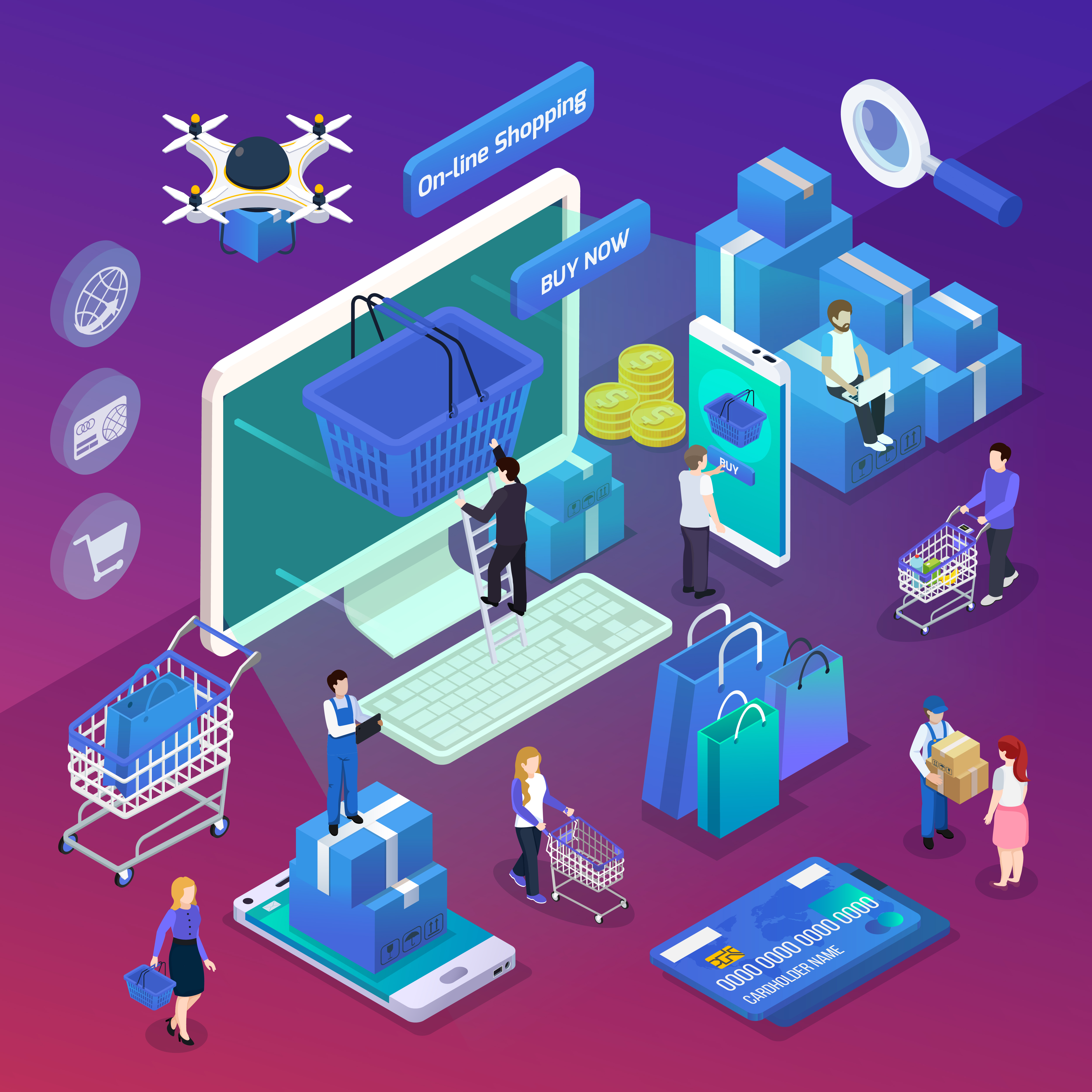
Retail used to be about shelf space and foot traffic. Then it became about clicks and conversions. Now it's about something more unsettling for most business operators: the store knows who you are before you arrive, predicts what you'll want before you search, and serves you an experience that is mechanically, algorithmically tailored to your behaviour patterns, mood signals, and purchase history.
This isn't a future scenario. It's the operational reality of every serious e-commerce player above a certain revenue threshold in 2026. The smaller operators and the students being trained for this industry are the ones still catching up, and the gap between understanding this shift intellectually and being equipped to work inside it professionally is wider than most business programmes have acknowledged.
The real disruption isn't that AI is entering e-commerce. It's that e-commerce has already been rebuilt around AI, and the business roles it creates look fundamentally different from the ones that existed five years ago.
- What the Shift Actually Means Beyond the Headlines
- What Learners and Professionals Are Actually Facing
- Who This Matters For And What Happens If They Look Away
- Why Structured Learning Is the Answer the Market Is Asking For
- 10 Ways AI Is Transforming E-commerce by 2030
- Where E-commerce Is Headed by 2030
- Key Takeaways
- Frequently Asked Questions
What the Shift Actually Means Beyond the Headlines
A common pattern in how businesses respond to AI adoption is what might be called 'cosmetic integration': deploying a chatbot on the homepage, running a recommendation widget, and calling it an AI strategy. What's actually happening in organisations that are winning is far deeper: AI is embedded in pricing logic, inventory decisions, customer lifecycle management, fraud detection, and content generation simultaneously. The difference between the two approaches isn't a technology budget gap. It's a talent and understanding gap.
Most coverage of Artificial Intelligence in E-Commerce focuses on the consumer-facing layer, the recommendation engine, the personalised banner, and the dynamic price. But the more consequential transformation is happening in the back office. Demand forecasting, supplier negotiation signals, logistics optimisation, and return prediction models are where AI is generating the most measurable margin impact. Businesses that only invest in the visible AI layer are leaving the more valuable efficiency gains untouched.
For students and professionals preparing for roles in this industry, the implication is direct: the skill sets that made someone employable in e-commerce three years ago, campaign management, product listing, and basic analytics, are now the floor, not the ceiling. The roles being created at the intersection of business strategy and AI in Digital Marketing require a fundamentally different kind of graduate.
What Learners and Professionals Are Actually Facing
The business student finishing a general management programme in 2026 and looking at e-commerce as a career path faces a specific and underacknowledged problem: the industry has moved faster than most curricula. They've studied consumer behaviour and digital marketing frameworks but haven't been shown how to work with the systems that now execute those frameworks automatically, at scale, in real time.
The working professional who has spent three years in a digital retail or marketplace role faces a parallel problem. They know the platform, but the platform is increasingly running on logic they haven't been trained to interpret, challenge, or direct. When their employer starts asking for 'data-driven decisions,' they aren't sure whether that means Excel, a BI dashboard, or something more fundamental.
And then there are the founders and small business operators who've been told that AI will level the playing field between them and the large platforms. What they're discovering is that levelling requires active adoption, not passive observation. The tools exist. The gap is in knowing which ones solve real problems and how to operationalise them.
Who This Matters For And What Happens If They Look Away
- Business and commerce graduates targeting roles in digital retail, marketplace management, or growth marketing
- Working professionals in e-commerce operations, category management, or digital strategy who want to move into senior roles
- Entrepreneurs running or planning direct-to-consumer businesses across any category
- Marketing and analytics professionals whose work is increasingly shaped by AI tooling they don't fully understand
- Professionals in highly specialised technical roles (logistics engineering, physical supply chain) where AI integration is still relatively early
- Students in the first year of a foundational business programme, the priority is building the business fundamentals first
One of the biggest gaps emerging in hiring for e-commerce careers in 2026 is between candidates who understand how AI systems shape commercial outcomes and those who simply know how to use the platforms these systems power. The former are being hired into strategic roles. The latter are being hired into roles that will be automated first.
Why Structured Learning Is the Answer the Market Is Asking For
The challenge with self-directed learning in this space is fragmentation. A YouTube course on AI tools, a certification in digital marketing, a weekend workshop on data analytics, none of these, individually or combined, produce the integrated understanding that employers are looking for. What they produce is a patchwork of surface knowledge without the strategic framework to deploy it.
A structured programme built around the intersection of business, digital commerce, and applied AI closes that gap differently. It doesn't just teach the tools; it teaches how to think about commercial problems through a lens that includes what AI can and cannot do, where it creates competitive advantage, and how to build organisations and strategies around its capabilities.
For students assessing the BBA in e-commerce career scope, the programme's relevance to this landscape is the most important evaluation criterion. A curriculum that still centres on traditional retail management without substantive coverage of AI-driven commerce is preparing students for a market that no longer exists at scale.
10 Ways AI Is Transforming E-commerce by 2030
The role of AI in digital commerce isn't a single story; it's ten parallel ones, each reshaping a different layer of how online business works. Here's what's already underway and where each track is heading.
01. Hyper-Personalisation at Scale
The recommendation engine is the most visible face of AI in e-commerce 2026. But what's actually happening beneath the 'you might also like' surface is a real-time assembly of individual experience pricing, content sequencing, homepage layout, and promotional timing built around behavioural data signals. By 2030, the gap between what two different users see on the same platform will be so wide that 'the website' as a fixed entity will be essentially obsolete.
02. Conversational Commerce and AI Chatbots
The early chatbot was a scripted FAQ robot. The current generation is something fundamentally different. AI chatbots in e-commerce now handle product discovery, size and fit guidance, post-purchase issue resolution, and reorder facilitation all in natural language, across WhatsApp, Instagram DMs, and platform interfaces simultaneously. The business student who understands how to design, manage, and optimise these systems has a genuine hiring edge.
03. Predictive Demand and Inventory Intelligence
Stockouts and overstocking are two of the most expensive problems in retail. Predictive analytics in e-commerce has moved from a competitive advantage to a baseline expectation for any operator managing more than a few hundred SKUs. AI models now integrate seasonal patterns, social trend signals, supplier lead times, and competitor pricing into inventory decisions that used to require a team of analysts and still produced significant error.
04. Dynamic Pricing and Margin Optimisation
Pricing in e-commerce used to be adjusted weekly or monthly. Now it's adjusted in real time, responding to competitor moves, demand signals, inventory levels, and customer segment behaviour simultaneously. The operators using AI-powered e-commerce pricing systems aren't just protecting margin; they're growing it, systematically, without manual intervention.
05. Visual Search and Immersive Commerce
The search bar is losing relevance. Platforms are rapidly integrating visual search, where a user photographs a product or uploads an image, and the system finds the closest match or complementary items. The next layer of this is the virtual shopping experience, where augmented reality lets users see furniture in their living rooms, try on glasses digitally, or walk through a virtual showroom. These aren't experimental features anymore; they are active conversion drivers on major platforms.
06. AI-Driven Content and Creative Automation
Product descriptions, ad copy, email campaigns, push notifications, and social content are increasingly generated, tested, and optimised by AI systems rather than content teams. This doesn't eliminate the need for human strategic and creative direction; it changes what that direction looks like. The professional who understands how to brief, evaluate, and iterate AI-generated content is more valuable than the one who can only produce it manually. Knowing the AI tools for e-commerce businesses that power this layer is now a core literacy requirement.
07. Fraud Detection and Secure Transactions
Payment fraud, account takeovers, and fake reviews are existential risks for e-commerce platforms. AI-powered payment systems now run real-time risk scoring on every transaction, analysing device fingerprints, behavioural patterns, network signals, and transaction history in milliseconds. The false positive rate (legitimate transactions declined) is falling while detection accuracy is rising, because the models are now trained on datasets large enough to distinguish genuine anomalies from legitimate outlier behaviour.
08. Logistics Optimisation and Last-Mile Intelligence
Route planning, delivery time prediction, return logistics, and warehouse picking sequences are all being transformed by smart e-commerce solutions built on AI. The result is measurable: lower delivery costs, faster turnaround, and significantly better customer satisfaction on the one metric that matters most in post-purchase experience: did it arrive when you said it would?
09. Customer Lifetime Value Modelling and Retention
Acquisition is expensive. Retention is where the margin is. AI systems now model customer lifetime value at an individual level, identifying which customers are worth aggressive win-back campaigns, which are price-elastic, which are high-churn risk, and which will respond to community or loyalty mechanics rather than discounts. Understanding the benefits of AI in e-commerce businesses at this strategic level is what separates a junior analyst from a retention strategist.
10. AI-Augmented Strategy and Market Intelligence
The most forward-looking application of AI in this space isn't operational; it's strategic. AI systems are now being used to monitor competitor positioning, track emerging consumer trends before they appear in search data, identify whitespace in product categories, and model the revenue impact of strategic decisions before they're executed. For students building future-ready business skills, understanding how to use these systems to make better strategic decisions, not just faster operational ones, is the most durable capability they can develop.
Where E-commerce Is Headed by 2030
The digital commerce trends 2026 are pointing toward a market that is simultaneously more automated and more human. The automation handles the transactional layer pricing, logistics, fraud, and personalisation. The human layer becomes more valuable precisely because it operates above all of that: strategy, brand building, creative direction, ethical AI governance, and the interpretation of what the systems are producing and why.
By 2030, the e-commerce professional who will be most in demand is not the one who has mastered a specific platform or tool. It's the one who developed the cognitive flexibility to operate in an environment where the tools change every eighteen months, but the underlying commercial logic that drives acquisition, retention, margin, and brand equity remains constant.
The question for anyone preparing for the future of e-commerce with artificial intelligence is not 'will I be replaced?' It is 'am I developing the layer of understanding that AI cannot replicate the strategic, contextual, and human judgment that sits above the system?'
Key Takeaways
- AI has already rebuilt e-commerce's operating layer. Personalisation, pricing, logistics, fraud, and content are all AI-driven at scale
- The visible AI (chatbots, recommendations) is less impactful than the invisible AI (demand forecasting, margin optimisation, CLV modelling)
- The talent gap is not in AI engineers; it is in business professionals who understand how AI shapes commercial outcomes
- Students building digital business skills in this environment need structured exposure to AI-commerce intersections, not just platform certifications
- Roles being created now reward strategic AI literacy over pure technical execution
- The AI skills for business students that matter most are interpretive and strategic, knowing what to ask the system, not just how to operate it
- Waiting to upskill in this space means entering a talent market where the benchmark has moved and keeps moving
Frequently Asked Questions
The transformation is happening across every layer simultaneously, from customer-facing personalisation to back-office demand forecasting. Understanding how AI is used in e-commerce today means recognising that it is not a single feature or function but an operating system for the entire commercial stack. Pricing, content, logistics, fraud detection, and customer lifecycle management are all being run, in part, by AI models in any serious e-commerce operation.
Modern AI chatbots do far more than answer FAQs. They handle product discovery conversations, guide sizing and fit decisions, manage post-purchase queries at scale, and facilitate reorders all without human intervention. The commercial impact is measurable in conversion rates, support cost reduction, and customer satisfaction scores. For business students, understanding how to design and optimise these systems is a core digital business skill, a requirement that most general management programmes still don't cover in sufficient depth.
The future business careers that e-commerce creates will reward four skill clusters: AI literacy (understanding how systems make decisions and how to direct them), data interpretation (reading commercial signals from analytics, not just reporting them), strategic thinking (understanding how the technology layer maps to business outcomes), and adaptability (being able to learn new tools without losing the underlying commercial framework). These are cultivated through structured programmes, not individual certifications.
Some roles will shrink, specifically those focused on repetitive execution that AI now handles faster and more accurately. But the net effect on talent demand is expansion, not contraction. The AI in Digital Marketing and broader e-commerce AI layer requires professionals who can interpret outputs, make strategic decisions, manage AI systems, and build brands in environments where the transactional layer is largely automated. The question isn't whether there will be jobs; it's whether the professionals entering the market are prepared for the ones that are actually being created.