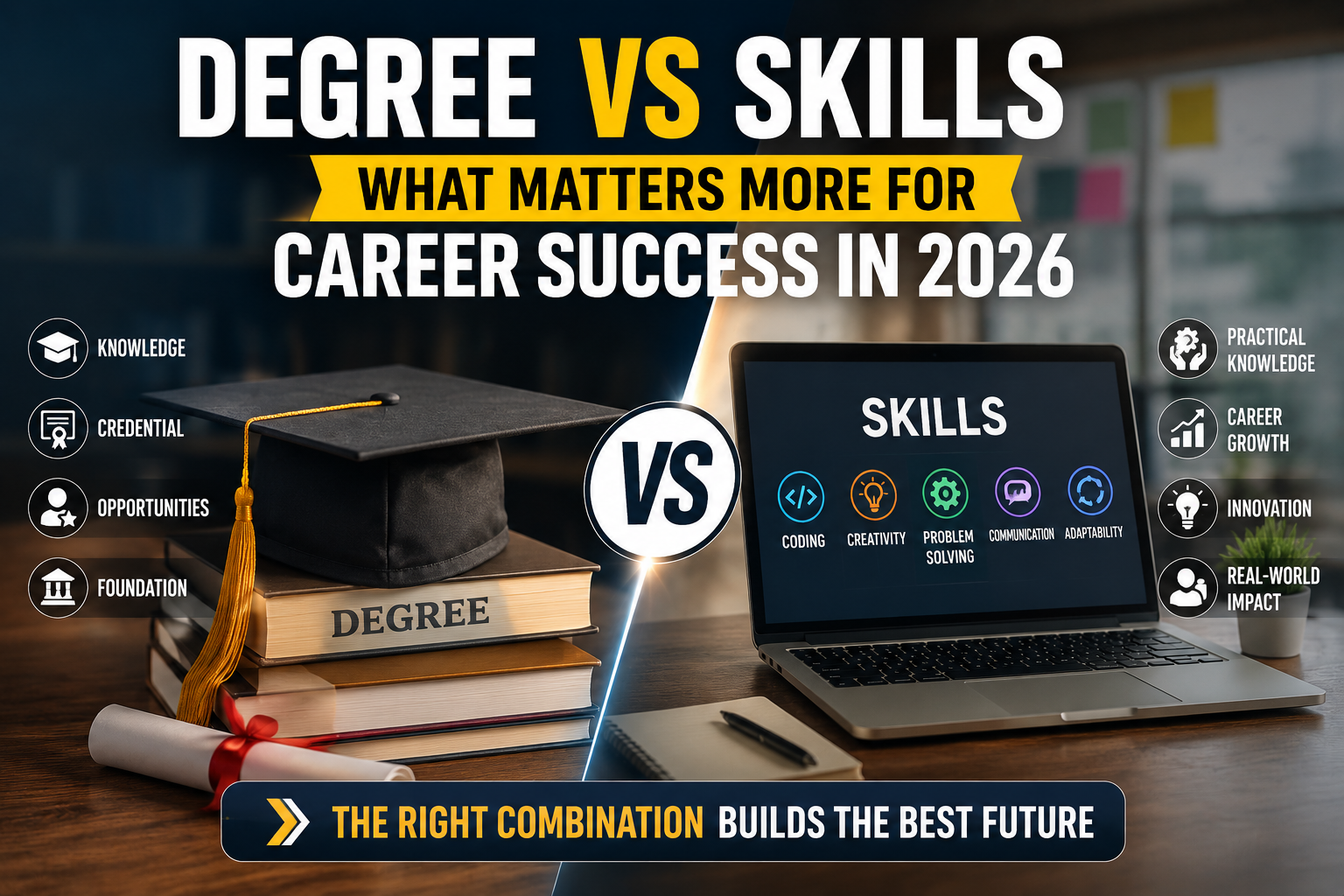
For decades, the answer was settled: get a degree, get a job. The credential was the career. Then the proxy started breaking down.
Employers used the degree as a proxy for capability, discipline, and social fit, and for most professional categories, it worked well enough. The degree signalled something real, even when it didn't directly build anything specific.
Then the proxy started breaking down. Companies started watching employees arrive with degrees and immediately requiring months of internal training before they were functional. Bootcamp graduates started outperforming degree holders in technical interviews. Platforms like LinkedIn and GitHub turned individual skill demonstration into a parallel credentialing system that recruiters learned to read alongside or sometimes instead of the transcript.
Now the debate has shifted again. The most sophisticated employers in 2026 are not asking 'degree or skills?' They are asking something more precise: does this candidate have the capability to do the work, and does the credential they hold give me confidence that the capability is real and durable? That question doesn't have a single answer. It has a framework. And most students are not being taught to navigate it.
- Why the Debate Is Real And Why Both Sides Are Partly Wrong
- Three Positions Students Are Actually Standing In Right Now
- Who Needs What: The Honest Breakdown
- The Architecture That Closes the Gap: Degrees Built on Skills
- What the Market Is Actually Evaluating And How to Build Toward It
- Roles Being Created at the Degree–Skills Convergence Point
- Where the Degree–Skills Balance Is Heading by 2030
- Key Takeaways
- Frequently Asked Questions
Why the Debate Is Real And Why Both Sides Are Partly Wrong
A common pattern in how this debate plays out in hiring rooms is that it separates cleanly by role type and career stage. At the point of entry, particularly for technical roles, demonstrated skill is increasingly the primary screen: the GitHub portfolio, the project work, and the problem-solving assessment. At the point of promotion, and especially for leadership-track roles, the degree re-enters as a signal of structured thinking, academic rigour, and domain depth. Employers who say 'we don't care about degrees' are usually referring to entry-level technical hiring. The same employers often have very different criteria for directors and above.
The mainstream argument from the 'skills over degrees' camp often underestimates what a well-designed degree actually builds. The importance of higher education is not primarily about the credential it is about the three to four years of structured intellectual development that a rigorous programme provides: the ability to learn systematically, to synthesise across disciplines, to think under examination conditions, and to build a professional identity within a domain. These are not outcomes that most short-form skill courses produce, because they require sustained time, difficulty, and iteration, not just content consumption.
Equally, the case for degrees collapses when the degree is generic, the curriculum is outdated, and the graduate cannot demonstrate a single applied skill that translates to the role they want. A degree from a well-regarded institution in a relevant field, with a curriculum that has been updated to reflect current professional demands, is worth significantly more than the same credential from a programme that hasn't revisited its syllabus in a decade. The degree vs skills which is more important debate is actually a proxy for a more precise question: is this degree building real capability, or just conferring a certificate?
The consequence of getting this wrong is career misalignment in one of two directions: the skills-only graduate who hits a ceiling at the mid-career stage because they lack the structured domain depth that senior roles require, or the degree-only graduate who can't pass the applied capability screens that now precede most offers. Both outcomes are common. Both are avoidable with the right framework at the decision stage.
Three Positions Students Are Actually Standing In Right Now
The student finishing school in 2026 has absorbed more contradictory career advice than any generation before them. Their LinkedIn feed tells them degrees are obsolete. Their parents tell them a degree is non-negotiable. A recruiter they spoke to said they hired purely on portfolio. Another one rejected them without a bachelor's listed on the application. The contradictions are real, and they exist because the answer genuinely varies by industry, role, and career stage.
There's the student who is technically gifted, who has built projects, learned frameworks independently, and can demonstrably do the work, but who is being pushed toward a three-year degree programme that will teach them things they already know. For this student, the question isn't whether to develop skills. It's whether the degree adds enough above what they already have in credential value, network, depth, and structured learning to justify the time and cost.
There's the student with no clear skill focus who is hoping a degree will provide direction. For this student, the degree is genuinely valuable not primarily as a credential, but as a structured environment in which to discover aptitude, build habits of learning, and develop the domain knowledge that will anchor the first ten years of their career.
And there's the working professional who holds a degree and is now being told by the market that they need to demonstrate skills their programme didn't build. For this person, the question is not degree vs. skills. It's how to build the skills most efficiently, within the credential framework they already have, in a way that the market will recognise.
Who Needs What: The Honest Breakdown
- When the target profession has a formal credential requirement, such as medicine, law, engineering, or chartered accountancy, where the degree is not optional
- When the student lacks a clear skill focus and needs the structured environment of a programme to develop domain identity and learning habits
- When the target employer tier is large corporates, MNCs, the government uses the degree as a mandatory filter that skills alone cannot bypass
- When the degree is from a programme that has been built around an applied, current, industry-relevant curriculum rather than legacy academic content
- When the target role is in a field where demonstrated output is the primary hiring criterion, software development, design, data analysis, and content creation
- When the student already holds a degree and is repositioning into a new domain where applied capability will outweigh academic credentials
- When time and financial constraints make a full degree programme impractical, and the role target is accessible through a shorter, focused credential
The framing of degree or skills for career success as a binary choice is almost always wrong. The most career-resilient graduates are those who hold a degree that was itself built around skill development, where the credential and the capability are the same product, not separate investments. The question to ask of any programme is not 'is this a degree or a skills course?' but 'does this programme produce graduates who can demonstrably do the work the market is hiring for?'
Students who choose a degree without evaluating its skill output, or who build skills without a credentialing framework the market recognises, both face the same downstream problem: a gap between what they can do and what employers can verify. The future of degrees and skills in the job market is not one winning over the other; it is the two converging in programmes that are built to produce both simultaneously.
The Architecture That Closes the Gap: Degrees Built on Skills
The most important development in Indian higher education in the last five years is not the rise of skill courses. It is the emergence of degree programmes that have been fundamentally redesigned around employability where the curriculum maps directly to job functions, assessments mirror real professional tasks, and the graduate arrives with both the credential the market recognises and the applied capability the role requires.
The practical implication for students evaluating degree courses is that the evaluation criteria have shifted. It is no longer sufficient to assess a programme on institutional brand alone. The questions that now matter are: what does the curriculum build? What do graduates in this programme do in their first jobs? How frequently is the curriculum updated to reflect market changes? Does the institution have active industry relationships that translate into real hiring pathways?
The rise of skill based courses has created healthy competitive pressure on degree programmes, pushing institutions to demonstrate that their graduates can actually do the work, not just hold the credential. The programmes that have responded to this pressure by rebuilding their curriculum from the ground up are producing a different kind of graduate: one whose degree is not separate from their skills but is the evidence that those skills were built with rigour, depth, and structured progression.
For students choosing between a skill degree pathway and a traditional academic route, the most useful evaluation is practical: map the programme's stated learning outcomes against actual job descriptions in the sector you're targeting. If the language aligns, if the skills the programme claims to build appear directly in the requirements of the roles you want, that alignment is the most reliable signal of employability that any programme can offer.
What the Market Is Actually Evaluating And How to Build Toward It
The Employability Gap: What It Is and Where It Comes From
The term employability skills is used so frequently in Indian education discourse that it has nearly lost meaning. What it actually refers to is a specific and measurable gap: the distance between what a graduate can do on the day they receive their degree and what they need to be able to do to be immediately useful in the role they're being hired for. Nationally, this gap is large, estimated to affect the majority of graduates across disciplines. The cause is structural: most programmes were designed to produce academic proficiency, not professional readiness.
What Employers Are Actually Screening For
Understanding the skills employers look for in 2026 requires separating the signal from the noise. The most consistent themes across hiring data and employer surveys are: applied analytical ability (can you interpret data and make decisions with it?), communication clarity (can you explain complex ideas to non-specialists?), domain depth (do you understand the sector you're entering well enough to add value without extensive onboarding?), and adaptive learning (can you build new skills as the role evolves?). These are not 'soft skills' in the dismissive sense. They are the capabilities that determine whether a graduate can function independently within twelve months of hiring.
The Skills That Have the Longest Half-Life
One of the most useful frameworks for skills for career growth is to distinguish between skills that depreciate quickly (specific tools, platforms, software versions) and skills that compound over time (systems thinking, domain expertise, communication at senior levels, ethical judgment in complex situations). The students who build careers rather than jobs are consistently those who invest in the latter while staying current on the former. The specific tool you learn in 2026 may be obsolete in 2030. The ability to learn new tools quickly, evaluate their commercial application, and communicate their implications to a non-technical audience that compounds.
What the Workplace Itself Is Becoming
The future workplace skills that will be most valuable in the next decade are being shaped by three forces: AI augmentation (where humans manage, direct, and evaluate AI outputs rather than performing the tasks AI now handles), global collaboration (where team structures span time zones, cultures, and disciplines), and continuous learning (where the half-life of technical skill is short enough that learning speed matters as much as current knowledge). The graduates who will thrive in this environment are not those with the most skills at the point of graduation, but those with the best framework for continuing to build skills throughout a career.
Why Education and Skills Are Not Opponents
The importance of skills and education for career success is not additive it is multiplicative. Education without skill development produces graduates who know things but cannot do them. Skill development without educational depth produces professionals who can execute tasks but cannot contextualise, strategise, or lead. The most career-resilient graduates are those who experienced both simultaneously, where the degree programme itself was the vehicle for skill development, not a parallel track running beside it.
The Role of Structured Programmes in Skill Building
The advantage of career programs that integrate skill development into their academic architecture is not just curriculum content but the learning environment. Structured programmes provide peer challenge, faculty feedback, iterative assessment, and the kind of productive difficulty that standalone online courses rarely replicate. The student who completes a project under examination conditions, receives expert critique, and iterates on their output has developed something different from the student who watched a course and received a completion certificate. Both have learned. Only one has been tested.
Roles Being Created at the Degree–Skills Convergence Point
The roles with the strongest hiring momentum in 2026 are those that sit at the convergence of domain knowledge (what a good degree builds) and applied technical skill (what applied programmes develop). Here is where well-prepared graduates are landing:
📊 01 Data Analyst / Business Intelligence Analyst
What they need: Statistical literacy, data visualisation, business domain knowledge, SQL
One of the highest-volume entry roles for graduates across engineering, commerce, and science backgrounds. Requires both analytical skill and domain understanding to interpret data in context, a combination that the degree-plus-skill model produces more reliably than either track alone.
🤖 02 AI / ML Applications Specialist
What they need: Programming fluency, mathematics, applied ML frameworks, domain context
The layer of AI roles that involves implementing and operationalising machine learning models in real business contexts is not research, but deployment. Growing in demand across BFSI, e-commerce, healthcare, and logistics as companies move from AI experimentation to AI production.
🌐 03 Digital Marketing & Growth Analyst
What they need: Analytics platforms, SEO/SEM, content strategy, consumer behaviour knowledge
A role that is simultaneously creative and data-driven and that rewards the graduate who can hold both. The marketing function in a data-mature company is now as analytically demanding as any commercial role, and the graduates who combine strategic thinking with tool proficiency are consistently the most mobile in early careers.
💼 04 Product Manager – Technology
What they need: User research, systems thinking, communication, basic technical fluency, business judgment
Product management is the canonical 'degree AND skills' role; it rewards domain knowledge from formal education, communication skills developed through structured learning, and applied technical fluency from hands-on experience. Entry into this role is competitive but increasingly accessible to graduates from diverse academic backgrounds who have built the right applied layer.
🔐 05 Cybersecurity Analyst
What they need: Network fundamentals, security protocols, logical reasoning, continuous learning habit
One of the most structurally secure roles in technology. Demand consistently outpaces supply, the skill set requires logical thinking over advanced mathematics, and the field rewards the continuous learner since threat landscapes evolve faster than any single certification can capture.
⚙️ 06 Operations & Process Analyst
What they need: Process mapping, data tools, supply chain basics, communication
Increasingly in demand as companies apply data and AI tools to operational efficiency. Accessible to graduates from engineering, business, and commerce backgrounds with the right applied skills. One of the clearest examples of a role where domain knowledge (operations, supply chain) and tool proficiency (data analysis, process modelling) are equally weighted.
🏦 07 Financial Technology Analyst
What they need: Financial domain knowledge, data skills, regulatory awareness, programming basics
The fintech hiring market is explicitly looking for graduates who combine financial domain understanding with applied technical capability. This role category is growing rapidly across payments, lending, insurance, and wealth management, and it is one where a structured, domain-integrated degree programme outperforms both a general finance degree and a standalone coding bootcamp.
Where the Degree–Skills Balance Is Heading by 2030
The trajectory of the importance of skills in career growth is not a straight line toward skills replacing degrees. It is a convergence where the value of a degree will increasingly be measured by the skills it demonstrably builds, and where skill credentials will increasingly need the depth and rigour of academic validation to be trusted at senior career stages. By 2030, the most valued credentials will be those that are both degree-level in their rigour and depth and skill-verified in their applied output.
The institutions that will produce the most employable graduates in 2030 are not those with the most prestigious names; they are those that have most successfully rebuilt their academic architecture around the applied capability their graduates need to demonstrate. That rebuilding is already underway in the most forward-looking programmes. The students who choose those programmes now are not sacrificing prestige for practicality. They are choosing the version of prestige that the next decade will reward.
For students assessing the skills vs education question in this environment, the productive reframe is: which programmes have genuinely integrated both? The answer to that question, pursued honestly and specifically, is the most valuable career research any student can do before committing to a three-year programme.
Key Takeaways
- The degree vs. skills debate is a false binary — the most career-resilient graduates hold both, built through the same programme
- Employers screen differently by career stage: applied skills at entry level, degree depth at promotion and senior roles
- The value of a degree in 2026 is determined by what it builds, not just what it confers. Curriculum relevance matters more than institutional brand alone
- The most important skills for career longevity are those with long half-lives: systems thinking, domain expertise, adaptive learning, and judgment under ambiguity
- Programmes that integrate skill development into their academic architecture produce graduates who don't face an employability gap on arrival
- Seven high-momentum roles in 2026 consistently reward the degree-plus-skills combination and are accessible to graduates from multiple academic backgrounds
- The productive question is not 'degree or skills?' but 'which programme builds both with the rigour and market relevance that the roles I want actually require?'
Frequently Asked Questions
Across industries, the skills generating the strongest hiring signal in 2026 cluster around data fluency (the ability to work with data to make commercial decisions), AI literacy (understanding how AI systems work and how to direct them effectively), domain-specific technical skills in high-growth sectors (fintech, health technology, digital commerce), and communication at a senior level (the ability to translate technical outputs into business decisions for non-specialist audiences). What makes these skills particularly valuable is that they combine technical and interpretive components; they cannot be reduced to tool proficiency alone. The skills for career growth that compound most reliably over a ten-year career are those that sit at the intersection of technical capability and contextual judgment.
The honest answer depends on three variables: the role category, the career stage, and the quality of the degree programme. For entry-level technical roles in software, data, and design, demonstrated skills often outweigh credentials. For roles requiring regulated professional qualifications, the degree is non-negotiable. For leadership and strategy roles, domain depth typically built through structured academic experience re-enters as a primary differentiator. The most useful frame is not either/or but both/and: the value of a degree is highest when it is actively building the employability skills the market is asking for, not running parallel to them.
The degrees generating the strongest hiring outcomes in 2026 are those built around the sectors with structural demand growth: AI and data science, financial technology, digital commerce, health technology, and cybersecurity. What matters more than the specific field name, however, is the architecture of the programme, whether the curriculum maps to current job functions, whether the institution has active industry relationships that translate into hiring pathways, and whether graduates of the programme are demonstrably landing in the roles they targeted. Looking at future workplace skills requirements in the sector you want to enter, and then evaluating programmes against those requirements, is a more reliable method than ranking degrees by name recognition alone.
The skills with the highest and most durable value in 2026 combine technical fluency with human judgment. Data analysis and interpretation; AI literacy and prompt engineering for professional contexts; domain expertise in high-growth sectors; strategic communication and stakeholder management; and the meta-skill of continuous learning the ability to acquire and apply new capabilities quickly as tools and markets evolve. These are not individual certifications. They are capabilities built through sustained, structured exposure to real professional problems, which is why the importance of higher education remains relevant even as specific technical skills become accessible through shorter routes: the depth and rigour of a well-designed programme produce capabilities that standalone certifications rarely replicate.
The most effective approach combines three elements that most students access in isolation: curriculum-embedded applied projects (where the assessed work mirrors the kind of output a role would require), industry exposure through internships or live case work (where the student encounters real constraints, real data, and real stakeholder expectations), and deliberate portfolio building (where the applied output from both the programme and any additional projects is documented and demonstrable at interview). Students enrolled in programmes designed around career programs that integrate all three of these elements are typically more job-ready at graduation than those who complete a strong academic programme and build the applied layer afterwards because integration during learning produces a different kind of competence than addition after it.