A career guide for students, parents, and anyone rethinking where they want to go professionally in 2026
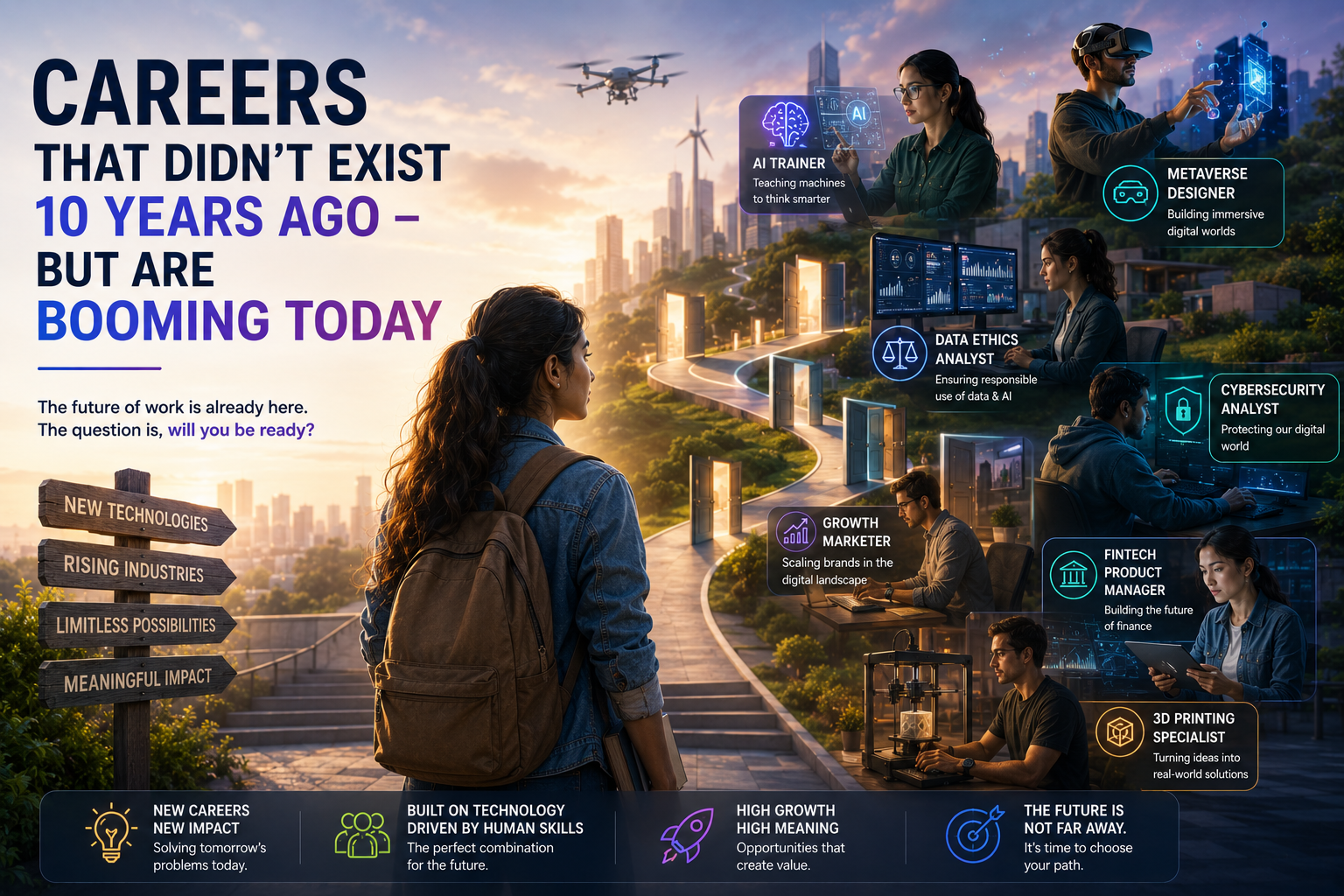
In 2014, no one was being hired as a prompt engineer. No company had a Chief AI Ethics Officer. The phrase "growth hacker" would have drawn blank stares at most recruitment desks. Cybersecurity teams were small, underfunded, and largely invisible. Fintech was not a sector; it was a footnote in a conversation about banking apps. Today, all of these are legitimate, well-compensated, and actively expanding career categories. They did not evolve slowly. They appeared, scaled, and became mainstream within a decade.
This matters enormously for anyone currently in Class 11 or 12, anyone pursuing an undergraduate degree, and anyone who feels like the career they prepared for is quietly becoming less relevant. The job market of 2026 does not look like the one students were being counselled toward in 2018. Understanding what has changed specifically, which careers have emerged, and why is one of the most practically useful things a student can do before choosing a discipline.
- Why New Careers Appear Faster Than Anyone Planned For
- For Students at the Starting Line: Choosing in 2026
- AI: The Largest Category of New-Era Jobs
- Cybersecurity: The Career Category That Grew With Every Breach
- Business Analytics: Where Data Meets Decisions
- Digital Marketing: A Sector That Reinvents Itself Every Two Years
- Fintech: The Fastest-Moving Sector in the Indian Economy
- Careers in Technology That Do Not Require Coding
- The Sectors No One Is Fully Prepared For
- The Skills Behind the Careers: What to Actually Build
- Technology-Driven Careers: The Unifying Thread
- Career Comparison: At a Glance
- Key Takeaways
- FAQs
Why New Careers Appear Faster Than Anyone Planned For
The fastest-growing industries in India in 2026, AI and machine learning services, cybersecurity, digital commerce, fintech infrastructure, cloud computing, and data analytics share a common origin: they emerged from technological shifts that created demand for human skills that no established profession had previously developed. When technology moves faster than institutions can respond, the gap fills with new roles. That is the pattern behind every career on this list.
The honest signal for students thinking about future careers is this: the careers most likely to be stable and well-compensated in 2035 will not all be defined yet in 2026. The students with the most durable career positions are those who develop adaptable skill foundations in AI, data, digital systems, and domain expertise rather than preparing exclusively for a fixed role title that may look different in five years.
Every major career category that is booming today was initially resisted by traditional hiring managers. Cybersecurity was once considered a specialism for IT departments, not a C-suite concern. Data science was considered a subset of statistics. Digital marketing was considered less serious than traditional advertising. In each case, the market overrode institutional hesitation within a decade.
For Students at the Starting Line: Choosing in 2026
The question of best career options after 12th is being asked in a fundamentally different context in 2026 than it was when today's parents made similar decisions. The answer is no longer a shortlist of stable professions from a stable list of sectors. It is a framework: choose a discipline that sits at the intersection of a growing industry and a skill category that AI augments but does not replace. That intersection of human judgment applied to AI-influenced environments is where the most durable opportunities are concentrated.
For students who have completed Class 12 and are asking what career should I choose, the most useful reframe is from "which job title sounds good" to "which skill cluster is growing and which industries are building infrastructure around it." The job titles will keep changing. The skill clusters AI literacy, data interpretation, digital systems, cybersecurity, and domain expertise are more durable than any particular role name.
The students who are most likely to regret their degree choice are those who chose a discipline because it was safe, because it had always produced employment, without checking whether the demand for that discipline was growing or contracting. Safety and relevance are not the same thing.
AI: The Largest Category of New-Era Jobs
AI careers have expanded from a narrow band of research and engineering roles into an ecosystem that touches almost every sector. The roles being hired for in 2026 include: machine learning engineers who build and fine-tune models, AI product managers who translate AI capability into usable products, prompt engineers who design the inputs that make AI systems perform reliably, AI trainers who evaluate and improve model outputs, and AI ethics analysts who assess risk and fairness in AI deployment. Most of these job titles did not exist in their current form a decade ago.
The breadth of jobs of the future connected to AI is wider than most students assume. It extends into healthcare (AI diagnostic support roles), law (AI-assisted legal research and contract analysis), finance (AI-driven risk modelling and fraud detection), and education (AI curriculum personalisation). Students who combine domain expertise with AI fluency, a doctor who understands how AI diagnostic tools work, a lawyer who can evaluate AI-generated legal research, are entering a career category that will be among the most valued in the next decade.
🤖 Machine Learning Engineer / AI Engineer
- 💰 Salary Range (India): Rs. 7 – 16 LPA (entry to mid)
- 🛠️ Key Skills: Python, ML frameworks, data pipelines, model deployment
- 🎓 Degree Pathway: B.Tech Computer Science / AI / Data Science
- 📈 Outlook: Very high demand. Shortage of qualified candidates persists through 2027+
(source: PayScale)
Cybersecurity: The Career Category That Grew With Every Breach
Cybersecurity careers have been on a steep growth trajectory for six years and show no sign of slowing. Every major digital infrastructure investment, cloud migration, fintech expansion, digital government services, and healthcare digitisation increases the attack surface that organisations must defend. India is significantly underserved in cybersecurity talent: estimates consistently place the gap at several hundred thousand professionals, and the gap is growing faster than institutions are producing graduates.
The in demand jobs within cybersecurity in 2026 span a wide range of seniority and specialisation: SOC (Security Operations Centre) analysts monitoring threats in real time, penetration testers identifying vulnerabilities before attackers do, cloud security architects designing secure infrastructure, incident response specialists managing breaches, and compliance analysts navigating the regulatory frameworks (GDPR, India's DPDP Act, sector-specific regulations) that now govern data security. Entry-level roles are accessible with a B.Tech and relevant certifications.
🔐 Cybersecurity Analyst / Security Engineer
- 💰 Salary Range (India): Rs. 5 – 12 LPA (entry to mid)
- 🛠️ Key Skills: Network security, threat analysis, ethical hacking, cloud security
- 🎓 Degree Pathway: B.Tech CS / IT / BCA + certifications (CEH, CompTIA Security+)
- 📈 Outlook: Critical shortage of talent. Government and enterprise demand are both accelerating
(source: PayScale)
Business Analytics: Where Data Meets Decisions
The role of the business analyst is not to process data; software does that, but to interpret it, question it, contextualise it, and translate it into decisions that non-technical stakeholders can act on. That translation function is deeply human, and it is in consistently high demand. Business analytics jobs represent one of the clearest examples of a career category that emerged from the collision of data availability and the need for human interpretation. Organisations are now generating more data than they have ever been able to act on.
What makes this a future-proof job category for students is the sector breadth. Business analysts are being hired in manufacturing (to interpret production efficiency data), in healthcare (to analyse patient outcome trends), in retail (to model customer behaviour and inventory), in government (to evaluate programme performance data), and in every segment of the financial services industry. The skill is domain-agnostic; the domain knowledge is what differentiates candidates at the senior level.
📊 Business Analyst / Data Analyst
- 💰 Salary Range (India): Rs. 5 – 10 LPA (entry to mid)
- 🛠️ Key Skills: SQL, Excel, Power BI, Python basics, data storytelling, business acumen
- 🎓 Degree Pathway: BBA / B.Com / MBA with analytics focus or B.Tech
- 📈 Outlook: Consistently ranked among the top 10 most-hired roles in India. High volume, steady growth
(source: PayScale)
Digital Marketing: A Sector That Reinvents Itself Every Two Years
The role that existed in 2015, primarily managing social media accounts and running basic search ads, bears little resemblance to the strategic, data-driven, AI-augmented function that senior digital marketers perform today. Growth marketers run multi-channel acquisition experiments. SEO strategists work at the intersection of content, technical architecture, and AI-search optimisation. Performance marketing managers operate sophisticated attribution models across paid channels. The discipline has deepened significantly. Digital marketing careers have undergone more internal transformation in the last decade than almost any other profession.
The connection between careers after 12th and digital marketing is worth making explicit: this is one of the more accessible entry points into a well-compensated professional career for students from any academic stream. Science, commerce, and arts graduates can all enter the field. The learning curve is steep, the certification ecosystem is extensive, and the career progression for strong performers is fast. The ceiling in digital marketing at the senior and leadership level is high.
📱 Digital Marketing Specialist / Growth Manager
- 💰 Salary Range (India): Rs. 4 – 9 LPA (entry to mid)
- 🛠️ Key Skills: SEO/SEM, content strategy, paid media, analytics, AI content tools
- 🎓 Degree Pathway: BBA / Mass Communication / any UG + digital certifications
- 📈 Outlook: High volume hiring. AI integration is creating new specialist roles in AI-powered marketing
(source: PayScale)
Fintech: The Fastest-Moving Sector in the Indian Economy
Fintech careers have grown dramatically with the expansion of India's digital payments infrastructure, the rise of neobanks and lending platforms, the integration of AI into credit scoring and fraud detection, and the regulatory evolution that has created new compliance and governance roles. Fintech is not a company type; it is a layer that now sits across banking, insurance, wealth management, and payments. The professionals being hired to build, manage, and regulate this layer are some of the best-compensated in the country.
The high-paying careers in 2026 in fintech include product managers who design financial technology products (starting salaries at established fintechs range from Rs. 10–18 LPA), data scientists who build credit and risk models, regulatory and compliance specialists who navigate RBI guidelines and data protection law, and AI engineers who develop the fraud detection and customer personalisation systems that define competitive advantage in the sector. The combination of technology and financial domain knowledge is the profile most actively sought.
💳 Fintech Product Manager / AI Risk Analyst
- 💰 Salary Range (India): Rs. 8 – 18 LPA (entry to mid)
- 🛠️ Key Skills: Product thinking, financial systems knowledge, data analysis, regulatory awareness
- 🎓 Degree Pathway: B.Tech AI / Data Science + Fintech | MBA Finance with tech exposure
- 📈 Outlook: Among the highest-growth, highest-paying new-era career categories in India
(source: PayScale)
Careers in Technology That Do Not Require Coding
Careers in technology without coding is a search that reflects a real and legitimate concern: not every student who wants to work in the technology sector wants to spend their days writing code. The good news is that the most rapidly growing sectors, AI, fintech, digital commerce, cybersecurity, and cloud, have created an extensive range of professional roles where technical literacy is valuable but programming is not the primary skill. UX researchers, product managers, AI ethics analysts, cybersecurity compliance officers, digital marketing strategists, business analysts, and e-commerce managers all sit within the technology-influenced economy without requiring a software engineering background.
Students pursuing the best careers for the future without a coding background should focus on building the adjacent skills that make them effective at the boundary of technology and business: data interpretation, product thinking, digital tool fluency, stakeholder communication, and the ability to translate technical outputs into business decisions. These skills compound over time and create career trajectories that are difficult to automate precisely because they are human-in-the-loop by design.
The most valuable professionals in technology companies in 2026 are not always engineers. Product managers, UX leads, AI ethicists, and business strategists who can translate between technical teams and business decision-makers are frequently both scarcer and more senior than their engineering counterparts. The scarcity drives the compensation.
The Sectors No One Is Fully Prepared For
The emerging careers in India that are in active early-stage growth in 2026 include: climate technology roles (carbon accounting, green energy project management, sustainability reporting), space technology support roles (India's expanding space sector is creating engineering and project management demand), AI governance and policy (as regulatory frameworks develop), quantum computing research and support (early stage but growing fast at major institutions), and precision agriculture technology (where AI, IoT, and data analytics are transforming Indian farming at scale). None of these categories was a significant career destination a decade ago.
The common thread in careers that will grow in future is not a single technology or a single sector, it is the intersection of human judgment with technology-generated information. As AI handles more of the data processing and pattern recognition layer of work, the roles that grow are those requiring interpretation, contextualisation, ethical assessment, and communication of AI outputs. Students who understand this dynamic are not just choosing a career for today, they are positioning themselves for the career landscape that will exist in 2030 and 2035.
The Skills Behind the Careers: What to Actually Build
The future skills for students in 2026 fall into three non-negotiable categories and one emerging one. The non-negotiables: AI tool fluency (the ability to work with, evaluate, and apply AI-generated outputs in professional contexts); data literacy (the ability to interpret, question, and communicate quantitative information); and domain expertise (deep knowledge of a specific sector, such as finance, healthcare, retail, logistics, law, that gives AI-assisted work its context and quality). The emerging category: AI ethics and governance, the ability to assess risk, fairness, and accountability in AI systems, which is increasingly a regulated function.
Students building toward future-ready careers should think of skill development as a portfolio, not a single subject. The portfolio that produces the strongest outcomes in 2026 combines one area of domain depth (business, healthcare, law, engineering, finance) with one area of technology application (AI/ML, data analytics, cloud, cybersecurity, digital marketing) and one layer of professional practice (communication, project management, stakeholder engagement). No single degree delivers all of this, but a degree designed around this model gets closer than most.
By 2029-30, the Indian economy is projected to have a shortage of over 1.5 million professionals in AI, data science, and cybersecurity roles combined. Students entering relevant programmes now will graduate into a market with structural excess demand, meaning career leverage at the starting line that previous generations of graduates did not have.
Technology-Driven Careers: The Unifying Thread
Technology-driven careers are not just careers in technology companies. There are careers in every sector where technology has become operationally central, which, in 2026, means most sectors. A logistics company managing AI-driven route optimisation is a technology-driven operation. A hospital deploying predictive diagnostic tools is a technology-driven operation. A retailer running personalised digital campaigns is a technology-driven operation. The professionals managing these functions do not all have computer science degrees, but they all need enough technology fluency to make decisions in technology-influenced environments.
The best career for the future is not defined by a title. It is defined by the intersection of growing demand, genuine skill development, and the adaptability to keep learning as the environment changes. The careers listed in this guide share all three characteristics, and the students who enter them with that mindset, rather than the expectation of a fixed and stable role, will be the ones who build the most durable professional trajectories.
Career Comparison: At a Glance
For students and parents making a structured comparison across the careers discussed in this guide:
| Career | Coding Required? | Avg. Starting Salary | Growth Rate | Suitable For |
|---|---|---|---|---|
| AI / ML Engineer | Yes | Rs. 7–15 LPA | Very High | B.Tech CS / AI |
| Cybersecurity Analyst | Partial | Rs. 5–10 LPA | Very High | B.Tech / BCA |
| Business Analyst | No | Rs. 5–9 LPA | High | BBA / B.Com / MBA |
| Digital Marketing Lead | No | Rs. 4–8 LPA | High | BBA / Mass Comm |
| Fintech Product Manager | Partial | Rs. 8–16 LPA | Very High | B.Tech + Business |
| Data Scientist | Yes | Rs. 7–14 LPA | Very High | B.Tech / BSc Stats |
| UX Researcher | No | Rs. 4–8 LPA | Moderate-High | Any + Portfolio |
| Cloud Solutions Architect | Yes | Rs. 9–18 LPA | Very High | B.Tech / BCA + Cert |
| E-Commerce Strategist | No | Rs. 4–8 LPA | High | BBA E-Commerce |
(source: PayScale)
Key Takeaways
- Every booming career in 2026 emerged from a technology shift that outpaced institutional responses. The students who understand this pattern can anticipate where the next generation of careers is forming
- AI careers extend far beyond engineering roles, product management, ethics, training, and domain-specific AI applications are all growing categories with different entry requirements
- Cybersecurity has a structural talent shortage in India that will persist for years. It is one of the most reliable hiring markets available to technology graduates
- Business analytics is sector-agnostic and growing in every industry, making it one of the most transferable career foundations available
- Fintech is among the highest-compensated new-era career categories in India, rewarding the combination of technology and financial domain knowledge
- Technology careers without coding are real, growing, and well-compensated. The technology economy needs translators, managers, and strategists as much as it needs engineers
- The skill portfolio that produces the strongest career outcomes: domain expertise + AI/technology fluency + professional communication
- The shortage of qualified talent in AI, data, and cybersecurity by 2030 means students entering these disciplines now will graduate into a market with structural excess demand
Start Building Your Future Career Today
Choose a programme designed for the careers that are growing right now.
BBA E-Commerce
For digital commerce, marketing & retail careers
B.Tech AI Data Science Fintech
For fintech, data & AI-driven finance careers
B.Tech AI and Data Science Business Application
For AI, analytics & business technology careers
Frequently Asked Questions
Several major career categories that are mainstream today did not exist in recognisable form in 2014. Prompt engineer, AI product manager, and AI ethics analyst are entirely new roles. Growth hacker, cybersecurity analyst at the current scale of demand, cloud solutions architect, and data scientist, as distinct professions from statistician or database administrator, are all careers that emerged in the last decade. Fintech product manager, UX researcher as a standalone profession, and e-commerce strategist as a senior business role are also effectively new. The common thread: all of them emerged from technological shifts that created demand for human skills that no existing profession had fully developed.
AI has directly created several new job categories: prompt engineer (designing inputs that reliably produce high-quality AI outputs), AI trainer (evaluating and improving model outputs through human feedback), AI ethics analyst (assessing fairness, bias, and accountability in AI systems), machine learning operations engineer (managing the deployment and monitoring of AI models in production), and AI product manager (translating AI capability into usable products). Beyond these dedicated AI roles, AI has transformed many existing roles, such as business analyst, marketing strategist, financial modeller, and legal researcher, to the point where the AI-fluent version of these roles is functionally a different career from the non-AI version.
The career categories that have achieved critical mass most recently include: AI governance and policy roles (as regulatory frameworks develop in India and globally), climate technology careers (carbon accounting, sustainability reporting, green energy project management), space technology support roles (expanding significantly with India's growing commercial space sector), quantum computing research support (early stage but institutionally present), and precision agriculture technology (AI and IoT applied to Indian farming). Within the more established new-era categories, the roles evolving fastest are those at the boundary of AI and professional domains: AI-assisted legal research, AI-driven financial modelling, and AI-augmented healthcare diagnostics.
The highest-compensated career categories in the new-era landscape, measured by starting salary and five-year trajectory in India, are: fintech product management and AI risk analysis (Rs. 8-18 LPA at entry to mid level), cloud solutions architecture (Rs. 9-18 LPA), machine learning engineering (Rs. 7-16 LPA), and data science at mid-level (Rs. 10-20 LPA with three to five years of experience). Cybersecurity architecture and AI governance roles at senior levels are reaching Rs. 25-40 LPA at established organisations. The pattern: the roles that require both deep technical knowledge and business or regulatory domain expertise consistently command the highest compensation because that combination is the scarcest.
Several of the highest-growth career categories in 2026 do not require programming as a primary skill. Business analyst, digital marketing strategist, fintech product manager, UX researcher, AI ethics analyst, cybersecurity compliance officer, and e-commerce manager are all roles where technology literacy is valuable, but code-writing is not the core function. These roles require the ability to work with technology-generated outputs, communicate across technical and non-technical stakeholders, and make decisions in data-rich environments. Students from commerce, arts, and business backgrounds can access these careers through the right combination of domain education and digital skill development.