The question isn't just whether the university is good. It's whether the programme is designed to produce the kind of graduate the current job market is actually looking for.
There is a tension running through Indian higher education that most institutions acknowledge privately but few address structurally: the gap between what a degree teaches and what a first job actually requires is widening. Students graduate with theoretical foundations but without the applied capability, industry exposure, or professional context that employers are increasingly expecting at the point of entry.
The response from most universities has been incremental, with an internship requirement added here, an industry speaker series there. What few institutions have done is redesign the degree architecture itself: building industry exposure, digital learning, and hands-on application into the programme structure from Year 1, not as add-ons but as integrated components of how learning happens.
The NewGen model at Adamas University is a response to exactly this gap. Understanding whether it is the right response and whether it is the right fit for a specific student requires looking at what the model actually does, not just what it promises. This article will help you navigate that decision.
- What the Industry Is Actually Asking For
- What Students Are Actually Navigating
- Is This the Right Choice? Who It Fits and Who Should Think Carefully
- The NewGen Model: How It Is Structured and What It Produces
- Programme by Programme: What You Study and Where It Takes You
- The Internship Layer: Why It Is Built In, Not Bolted On
- Is It Worth It? Evaluating the NewGen Value Proposition
- What the Career Outcomes Actually Look Like
- How the Three NewGen Programmes Compare
- Thinking About Admission: What to Know Before You Apply
- Where These Careers Are Heading: The Five-Year Signal
- Key Takeaways
- Frequently Asked Questions
What the Industry Is Actually Asking For
The phrase 'future-ready' appears in almost every university brochure in India today. What it rarely comes with is specificity, a concrete description of what future-ready means in terms of the skills, experiences, and professional behaviours that employers are looking for when they hire entry-level candidates.
The hiring signal from digital-first industries is consistent: they want graduates who can contribute quickly, who have worked with real tools in real contexts, and who understand how the industry they are entering actually operates, not just in theory, but in practice. This is what makes Adamas University Kolkata NewGen future-ready programs structurally different from programmes that deliver the same content through conventional classroom delivery alone.
In most cases, the graduates who struggle most in their first role are not the ones with the weakest academic records. They are the ones with no prior exposure to how a workplace operates, who have never been in a professional environment, never had to deliver under a deadline outside a classroom, and never had to apply a concept to a problem that didn't have a textbook answer. The NewGen model is specifically designed to eliminate that gap before graduation, not after.
The hidden implication in the current hiring environment: academic performance is no longer a sufficient signal of job readiness. Employers in fast-moving sectors are now screening for evidence of applied capability alongside marks—portfolio work, internship experience, tool proficiency, and the ability to articulate what you have actually done, not just what you have studied. A programme that builds this evidence base as part of the degree is solving a real problem.
What Students Are Actually Navigating
Students researching degree programmes in 2026 are navigating a more complex decision than their predecessors did. They are being asked to choose between traditional degrees that carry familiar credibility and newer programme designs that claim better career outcomes but are harder to evaluate. They have parents and counsellors advising from frameworks formed in a different job market. And they are often making this decision without a clear picture of what their first job will actually require.
The specific anxiety most students carry into this decision: Will this degree get me a job? Not a theoretical job somewhere, but an actual offer from a company I would want to work for, in a role I can build a career from. This is the question the NewGen model is designed to answer, not with a placement statistic, but with a programme architecture that makes the outcome more likely by design.
One of the biggest gaps in how students evaluate universities is the assumption that a well-known name guarantees a strong career outcome. In practice, a programme that is structurally designed to produce industry-ready graduates with built-in internship integration, digital learning, and applied assessment often produces better early career outcomes than a more prestigious institution's conventional classroom-only programme. Brand recognition matters. But programme design matters more for the quality of the first five years.
The transition challenge is also worth naming honestly: students entering applied programmes like the NewGen model need to be self-directed in a way that conventional programmes do not require. The internship and digital learning components are not passive; they require initiative, professional communication, and the willingness to operate in environments where the answer is not given in advance. Students who thrive in this model are those who are ready to learn by doing, not just by studying.
Is This the Right Choice? Who It Fits and Who Should Think Carefully
Who is well-suited for a NewGen programme at Adamas:
- Industry Clarity: Students who are clear about wanting careers in digital-first industries, e-commerce, AI, fintech, and data analytics and want their degree to reflect that direction from Day 1.
- Applied Learners: Those who learn better through doing than through purely theoretical study, and who want the internship and applied components integrated into the degree rather than added after.
- Regional Focus: Students in Kolkata and eastern India who want access to industry-integrated education without relocating to a metro.
- Portfolio Builders: Those who are motivated to build a professional portfolio during their degree, not just a transcript.
Who should think carefully before choosing:
- Conventional Seekers: Students who are primarily motivated by a campus experience and peer environment, and for whom the applied and digital learning components feel secondary.
- Traditional Pathway Focus: Those who have a strong preference for highly conventional academic pathways targeting sectors like government service or traditional research.
- Undecided Students: Students who haven't yet clarified their career direction; the NewGen programmes are domain-specific.
What happens if the fit question is skipped?
A common pattern in career-focused programmes: students who choose them for the credential rather than
the content engage superficially with the applied components, produce weak internship experiences, and
graduate with a degree designed for career acceleration but without the capability the degree was meant
to build. The programme can only do so much; the student's engagement is the variable that determines
the outcome.
The NewGen Model: How It Is Structured and What It Produces
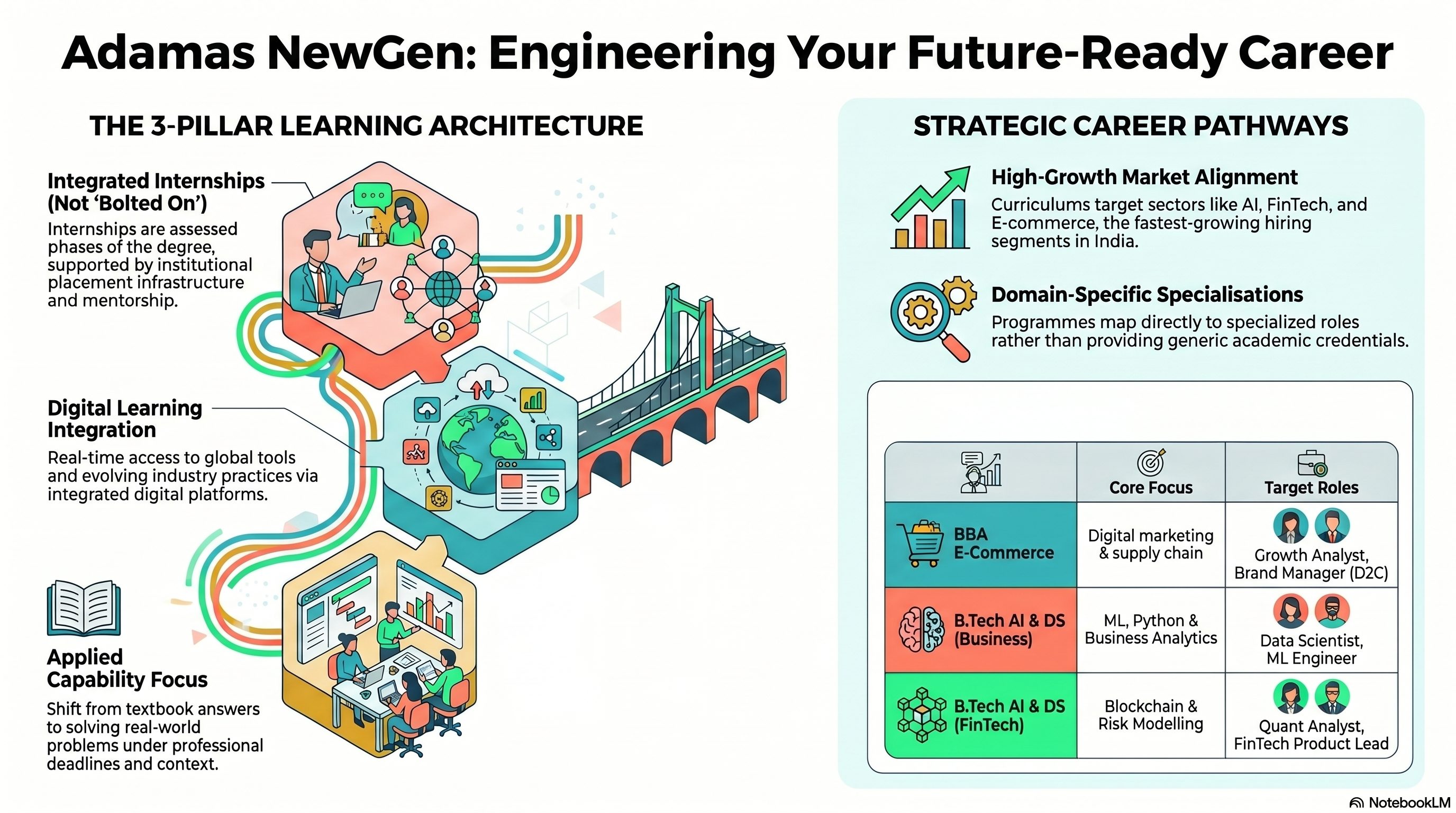
The three NewGen programmes—BBA E-Commerce, B.Tech in Artificial Intelligence and Data Science (Business Application), and B.Tech in Artificial Intelligence and Data Science (FinTech)—share an architectural logic even as their domains differ. Each is built around the same three-pillar model: classroom learning that establishes domain knowledge and academic rigour; internship and industry exposure that applies that knowledge in real professional settings; and digital learning that extends the curriculum beyond campus boundaries.
The Adamas University courses for future careers are designed with a specific career translation in mind for each programme. BBA E-Commerce maps to roles in digital commerce, brand management, and e-commerce operations. The B.Tech in AI and Data Science (Business Application) maps to data analyst, ML engineer, and AI product roles across industries. The B.Tech in AI and Data Science (FinTech) maps to roles in financial technology, quantitative analysis, and digital banking.
What makes the model substantively different from a conventional degree is the sequencing. Academic modules don't just precede internships; they inform them. The internship isn't a break from the programme; it is a phase of it. And digital learning isn't supplementary material; it is the medium through which global tools, current case studies, and evolving industry practices are brought into the curriculum in real time.
Programme by Programme: What You Study and Where It Takes You
| Programme | Core Learning Areas | Target Roles | Key Industries |
|---|---|---|---|
| BBA E-Commerce | Digital marketing, e-commerce operations, platform analytics, D2C models | E-Commerce Executive, Growth Analyst, Category Manager | E-Commerce platforms, D2C brands, retail-tech |
| B.Tech AI & DS (Business) | Machine learning, Python, business analytics, AI product design | Data Analyst, ML Engineer, BI Developer, Data Scientist | Tech companies, BFSI, healthcare, consulting |
| B.Tech AI & DS (FinTech) | Fintech fundamentals, credit risk modelling, blockchain, AI in banking | Quantitative Analyst, Risk Analyst, FinTech Product Analyst | Banks, NBFCs, fintech startups, investment platforms |
The FinTech specialisation within the AI and Data Science B.Tech is a relatively rare combination in Indian undergraduate engineering programmes. It maps directly to one of the fastest-growing hiring segments in the country. The combination of AI capability with financial domain knowledge is a profile that BFSI companies and fintech startups are actively finding difficult to hire.
The Internship Layer: Why It Is Built In, Not Bolted On
The question of whether Adamas University provide internship programs misses the more important point: it is not that internships are provided but that they are structurally integrated into the degree. This distinction matters more than it might appear.
An internship that is optional, or scheduled at the end of the degree as a standalone requirement, produces a fundamentally different learning experience than one that is timed to specific academic modules, assessed as part of the degree, and supported by faculty mentorship and industry connect infrastructure. The former is a credential line on a CV. The latter is a phase of professional formation.
In the NewGen model, the internship component is assessed, which means the institution has skin in the outcome. Faculty review the work, industry mentors provide feedback, and the performance during the internship is part of the academic record. This accountability structure is what separates a genuine industry exposure component from a checkbox.
Is It Worth It? Evaluating the NewGen Value Proposition
The question of whether Adamas University NewGen worth it is best answered not by comparing it to other universities in the abstract, but by measuring it against the specific outcome the student is trying to achieve.
For a student who wants to enter a digital-first career in e-commerce, AI, fintech, or data analytics and who is prepared to engage fully with the applied and digital learning components, the NewGen model offers a genuinely differentiated preparation. The curriculum is calibrated to current industry requirements. The internship is integrated rather than appended. The digital learning component keeps the programme current in a way that static syllabi cannot.
The honest qualification: the return on the NewGen model is directly proportional to the student's engagement. A student who treats the internship as a formality, skips the digital learning modules, and focuses only on passing examinations will not get the career advantage the programme is designed to produce.
What the Career Outcomes Actually Look Like
The question of whether is Adamas University good for career outcomes requires looking at three things: placement infrastructure, alumni trajectory, and employer connect.
Adamas University has a dedicated placement cell with corporate partnerships across sectors, including technology, finance, e-commerce, and consulting. For the NewGen programmes specifically, the placement focus is calibrated to the digital-first hiring market, meaning the companies being brought to campus and the roles being filled are aligned with the industry sectors the programmes are designed for.
The trajectory that matters most is not the first offer; it is the quality of the first role and how quickly the graduate can build on it. A student who enters a well-matched entry-level role with genuine applied skills and a portfolio of internship work is in a better position to grow quickly than one who enters a role for which they were only marginally prepared.
How the Three NewGen Programmes Compare
| Dimension | BBA E-Commerce | B.Tech AI & DS (Business) | B.Tech AI & DS (FinTech) |
|---|---|---|---|
| Programme type | Business degree | Engineering degree | Engineering degree |
| Core orientation | Digital commerce | AI for business functions | AI for financial services |
| Mathematics intensity | Moderate | High | High |
| Typical first roles | Marketing, operations | Data analyst, ML engineer | Risk analyst, quant analyst |
Thinking About Admission: What to Know Before You Apply
Approaching Adamas University admission for a NewGen programme warrants the same due diligence as any significant career investment. There are specific questions worth asking before submitting an application:
- What is the placement record for this specific NewGen cohort?
- What does the internship look like in practice? Is it assessed?
- Who teaches the core technical modules: practitioners or academics?
- What does the digital learning component involve (Coursera, NPTEL, etc.)?
- What companies have recruited from this specific programme?
These questions won't always produce complete answers at an open day, but the quality of the institution's response to them is itself a signal. An institution that can answer them specifically is one that takes its outcome accountability seriously.
Where These Careers Are Heading: The Five-Year Signal
By 2028–29, the three domains that the NewGen programmes target—digital commerce, AI-enabled business analytics, and financial technology—are projected to account for a disproportionate share of entry-level hiring growth in India's organised economy. The graduates entering these fields now are entering at the beginning of a sustained expansion, not at a peak.
More specifically, e-commerce is moving toward omnichannel and social commerce, AI in business is shifting from experimental to operational, and FinTech is entering a phase of regulatory maturation. Each of these trajectories favours the graduate who entered the field with domain specificity and applied experience, not the one who arrived with a generic business credential.
Key Takeaways
- The NewGen model is built around the integration of classroom learning, internship exposure, and digital learning.
- The three programmes are domain-specific by design, concentrating value for students with clear career interests.
- Internship value depends on structural integration, assessment, and institutional support.
- The FinTech track is highly specialised and maps to high-demand segments in the Indian economy.
- Programme return is proportional to the student's active engagement with applied components.
- Eastern India positioning provides metro-quality integrated education without relocation.
Frequently Asked Questions
Adamas University has a dedicated placement cell with a track record of corporate partnerships across technology, finance, e-commerce, consulting, and manufacturing sectors. For the NewGen programmes specifically, placements are calibrated to the digital-first hiring market—the companies engaged and the roles facilitated are aligned with the programme domains rather than drawn from the broadest available employer pool. Prospective students should ask for domain-specific placement data for the NewGen cohort specifically when evaluating this.
Adamas University is a UGC-recognised private university established under the West Bengal Act of 2014. NCTE (National Council for Teacher Education) approval is specifically relevant for B.Ed and teacher training programmes. For the NewGen programmes (BBA E-Commerce, B.Tech AI & DS), the relevant accreditation is UGC recognition and NAAC assessment, both of which govern the quality and recognition of degrees for employment and further education.
For students entering the right domains with genuine interest and full engagement, yes, the NewGen model is well-positioned for future careers in digital commerce, AI-enabled analytics, and financial technology. The programme architecture addresses the core gap between conventional degrees and current employer expectations. The honest qualification is that 'good for future careers' is a product of the match between the student's goals and the programme's design.
The NewGen model prepares students through three reinforcing mechanisms: Classroom experience builds academic foundations; Internship and industry exposure translate that foundation into applied skills; and Digital learning extends the curriculum beyond campus, bringing current tools and global case studies into the experience. The three components are integrated so each reinforces the others.
The NewGen programmes are designed with an explicit industry alignment curriculum that is built around current role requirements in their target sectors. The AI and Data Science programmes cover tools and methods actively used in industry today. The digital learning component is the mechanism that keeps the programme current, allowing access to the latest tools and practices in real time.